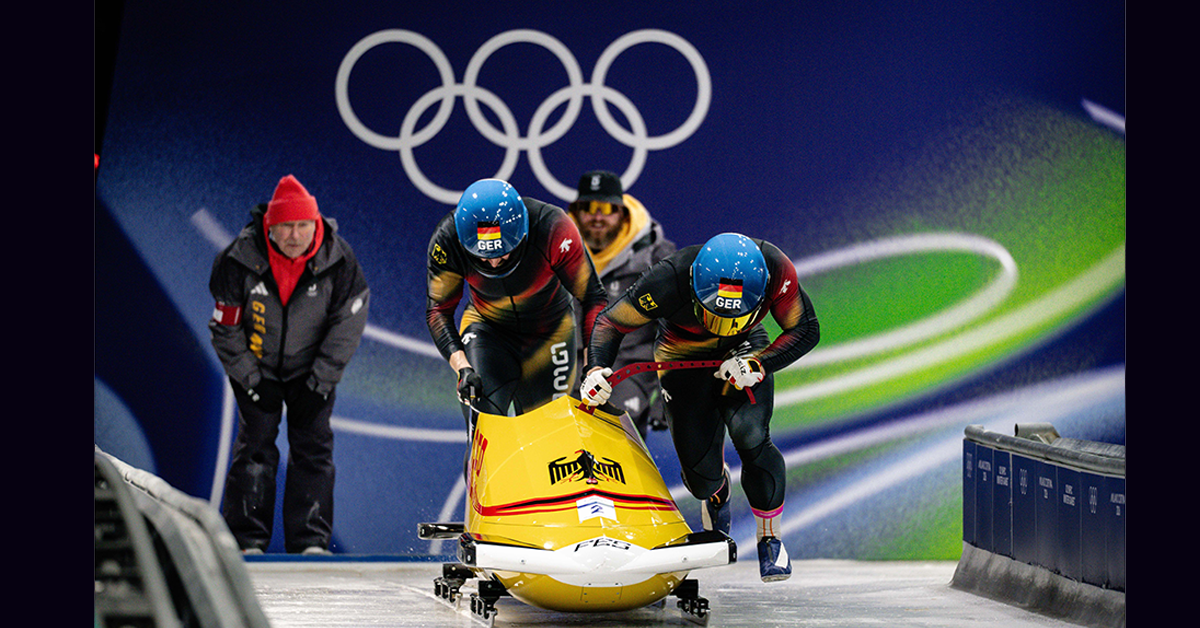
Bobsleigh is one of the most demanding examples of technical excellence in sport. Invented in Switzerland at the end of the 19th century, the sport made its Olympic debut at the first Winter Olympic Games in Chamonix, France, in 1924.
Today, bobsleigh is particularly popular in Germany, Switzerland, Austria, Italy, Canada and the United States.
Germany has long been recognised as one of the leading nations in international bobsleigh, combining sporting excellence with advanced engineering expertise. A significant contribution to this success comes from the Institute for Research and Development of Sports Equipment (FES) in Berlin.
Since its establishment in 1963, FES has played a central role in the development and design of high-performance sports equipment for Olympic and Paralympic athletes, including many of Germany's most successful bobsleighs and luge sleds.
At the Milano Cortina 2026 Olympic Winter Games, Germany once again demonstrated its strength in bobsleigh, winning seven medals, including three gold medals, and securing all three bobsleigh events for the third consecutive Olympic Games.
Bobsleigh is often compared with Formula 1 because success depends not only on the athletes' skill, but also on the engineering performance of the sled. Aerodynamics, materials technology, runner design, data analysis and manufacturing precision all contribute significantly to performance on the track.
Modern bobsleighs are highly engineered systems comprising precision-manufactured components such as chassis structures, steering systems, axles, braking mechanisms, body panels and steel runners. These components must be manufactured to extremely tight tolerances while meeting demanding requirements for strength, durability and weight optimisation.
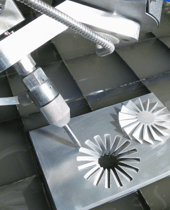
To achieve the required level of precision, FES relies on advanced manufacturing technologies, including abrasive waterjet cutting with GMA ClassicCut™ garnet for the production of various chassis and frame components. The process is also used for the near-net-shape cutting of blanks from semi-finished material, preparing components for subsequent CNC machining while reducing machining time and material waste.
Did You Know?
The name bobsleigh, or simply bob, is derived from the rocking or "bobbing" motion early athletes used before the start to build additional momentum. According to the International Bobsleigh & Skeleton Federation (IBSF), four-man bobsleighs can reach speeds of up to 155 km/h, making them among the fastest non-motorised sports in the world.





 GMA PremiumBlast™
 GMA NewSteel™
 GMA Fine
 Oil & Gas
 Industrial Fabrication & Maintenance
 Marine & Ship Building
 TruCost Blast Calculator
 Product Selector
 Brochure | GMA Garnet Blast Abrasives
 News: GMA's Roadmap to Sustainability
 Waterjet Parts
 GMA ClassicCut™ 80
 GMA ClassicCut™ 120
 Metal fabrication
 Glass cutting
 Stone cutting
 Case Study | GMA ClassicCut | Smith and Nephew
 Why is Garnet the preferred abrasive in Waterjet cutting?
 Water Filtration
 Rubber Fillers
 Anti-skid Products
 Ilmenite Sand
 Pyroxene
 Rutile